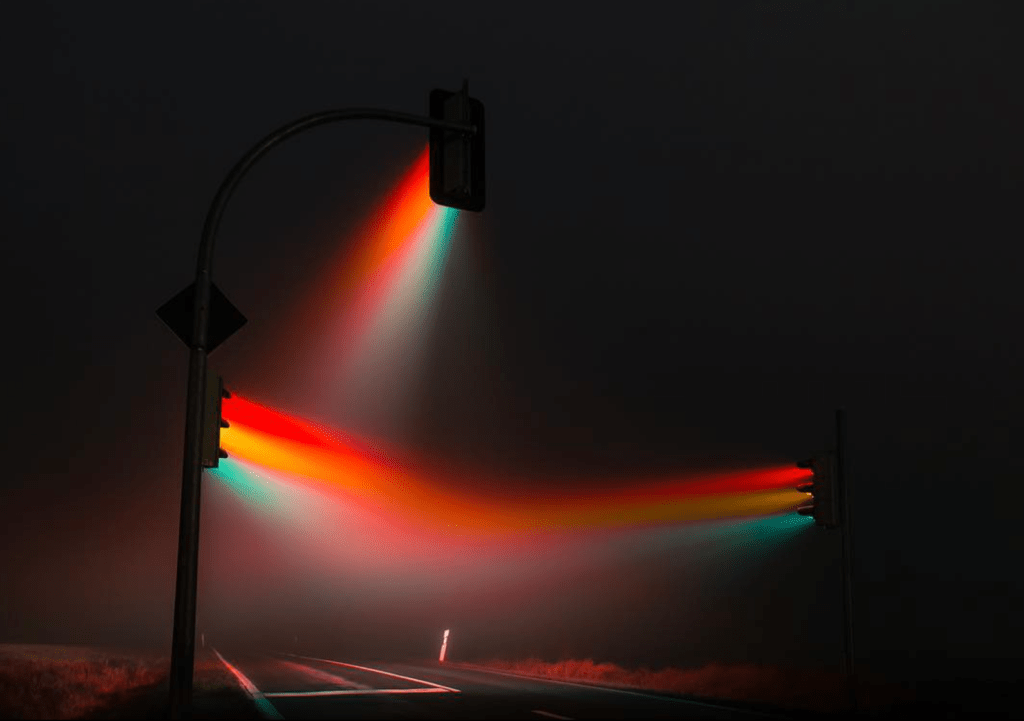
The night before, a torrential rain had fallen, and heavy clouds pressed low, sealing off the sky, while the rain dissolved countless neon lights into blurred, trembling fragments of colour—red, green, and yellow—so that even the leaves, beaten from the trees, seemed to drift endlessly into a dark sea that shimmered with scattered hues.
Tonight, the rain had stopped. Marcovaldo lay alone on the still-damp grass, gazing at the sky for a long time, tracing back through the fragments of his recent life, only to feel that somehow he was less than the moon hanging above him. He was exhausted—though he did not yet understand it—an exhaustion that had grown quietly within solitude itself.
It was a long dream, though Marcovaldo never realised it. In that dream, he tried to grasp the moon, yet it remained suspended at the edge of the sky, distant and unreachable, never descending. The city lay in complete darkness, and only the moon illuminated the night.
He rose from the grass and walked toward the sea not far away, where moonlight lay scattered across the surface of the water like fragments. He tried to catch those broken pieces of light, but they always slipped away from his hands.
At last, he leapt into the sea, as though shattering the moon itself into pieces. The cold struck him sharply—a piercing chill born of the autumn wind mingling with seawater. Fish brushed past his body as he plunged deeper, and somewhere in that descent, the moon, too, seemed to fall into the sea.
In the deep blue darkness, he caught sight of something white, pearl-like, emitting a faint and unreal glow. He swam closer, yet the vision vanished before he could reach it. Around him, silver fish began to appear, scattering like fragments of moonlight, drifting and dissolving. Those fleeting, weightless forms seemed to arise from within himself, like the countless thoughts he could neither grasp nor hold.
He paused, still unaware that he could breathe underwater, as everything continued as naturally as life on land. Around him, besides the scattered silver light, countless bubbles rose in silence. He reached out and gathered a small cluster of them in his hand, but in that very instant, they disappeared.
When he returned to the surface, the moon still hung high above, yet the distant sea flickered strangely with red and green lights. Slowly, almost imperceptibly, the moon was swallowed, and the sky grew brighter, until it was filled with fractured, restless light.
Marcovaldo awoke to find his body soaked through, lying in a shallow pool. Behind him, by the roadside, stood two sets of traffic lights facing one another—like strangers, or perhaps like friends, or lovers caught in a silent exchange.
A harsh light flickered across his face, but he paid it little attention, rising from the pool and wandering across the grass. The city was quiet now, as if only he remained within it. Passing cars occasionally cast their glaring headlights toward him, a brightness he could scarcely endure—like the light in his dream, burning, relentless, and unceasing.
He lifted his gaze to the sky, which was no longer the same as in his dream. The deep darkness had dissolved into a sky filled with artificial light, where even layers of clouds could be seen. The glow of countless high-rise buildings, the passing cars, and the lonely traffic lights had swallowed the moon into their brightness, and the stars, too, had been consumed, buried within illuminated clouds.
The buildings rose high, glaring with cold light, and Marcovaldo felt that in this excessively urbanised city, he had nowhere to stand. The patch of grass beneath his feet seemed the only place where he could pause.
From time to time, a bus passed by. Looking into its empty interior, Marcovaldo felt an inexplicable sadness. The white light inside resembled the light from his dream, yet it was not bright enough. Still, it unsettled him, as though it were trying to draw him back into some dark, damp basement.
Dragging his aching body, he made his way toward the sea and sat alone on a bench, letting the sea wind, the autumn air, and the distant sound of waves pass through him.
The traffic lights remained lit, unwilling to rest. Their pale, powerless glow spread thinly across the road, while in the distance the city still glittered with excess light. Water from his clothes seeped into the bench beneath him, and the moon seemed to rise slowly from the sea, only to sink back again.
He glanced at his watch—it was already three in the morning. Strangely, his heartbeat felt unusually loud, as though some force were moving through his body, searching for a way to break free.
He longed to see the moon from his dream once more—on a night that was utterly dark and silent, where there would be nothing but the moon, the sea, a few faint stars, and himself. Perhaps in the dim depths, perhaps upon the shimmering surface, the moon would slowly emerge again.
Marcovaldo lay back on the bench, water dripping from his clothes and sinking into the ground. The sky grew so dark that almost nothing could be seen.
Later, just before the sun rose, the moon appeared once more at the edge of the sky, faint and distant, and his clothes were nearly dry. The sound of passing cars grew louder, so loud that the traffic lights no longer flickered like neon signs. The sky was half deep blue, half ink-black, and the buildings no longer cast their oppressive glow.
Marcovaldo lay there in stillness. He reached out, grasped the moon, and sank with it—and the stars—into the sea.
At that moment, the morning sun began to rise. Fallen leaves drifted gently onto his face, while in the water below, his reflection moved softly with the current.
1,006 words
This work is a derivative piece inspired by the original text, Marcovaldoby Italo Calvino.
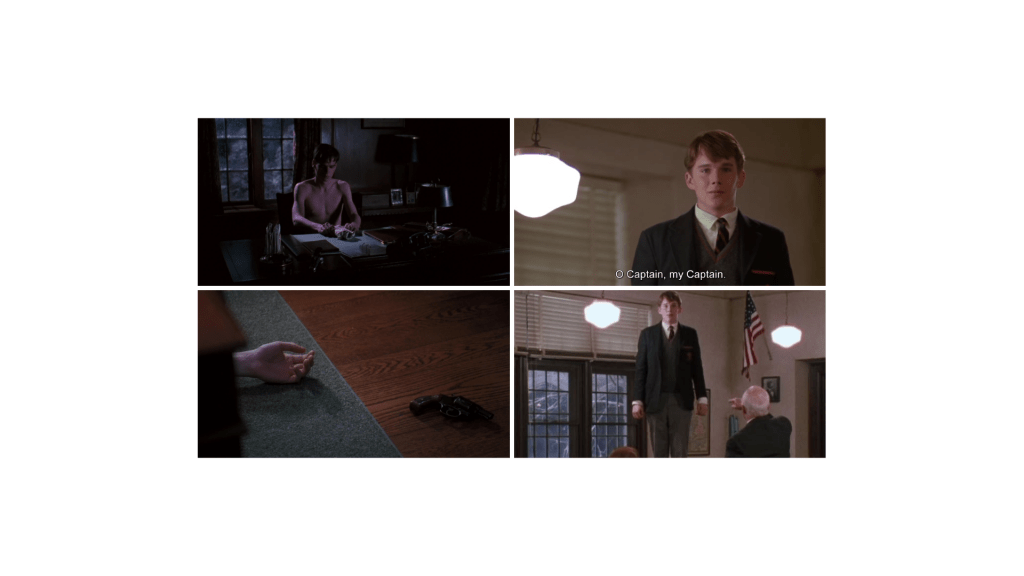
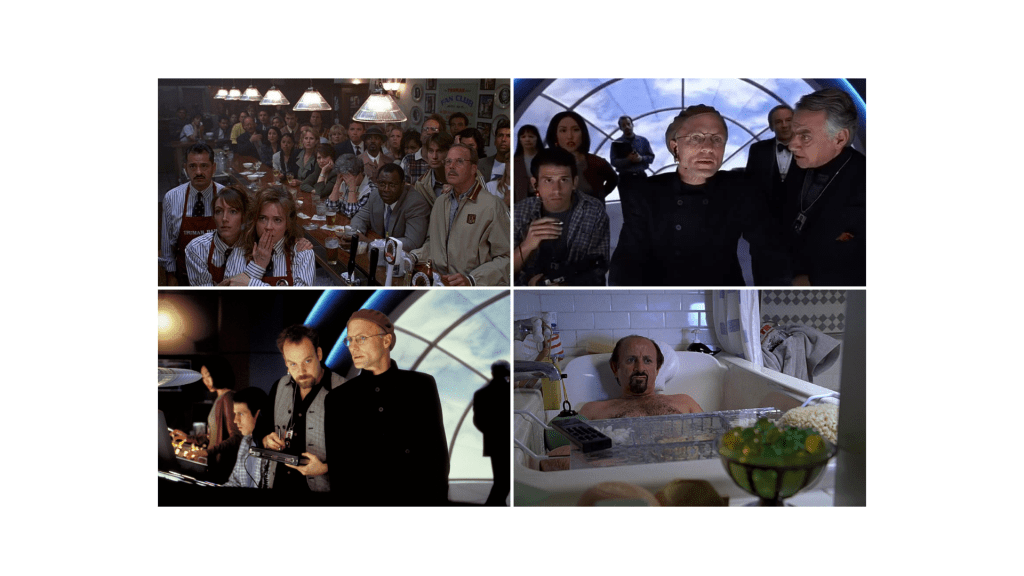
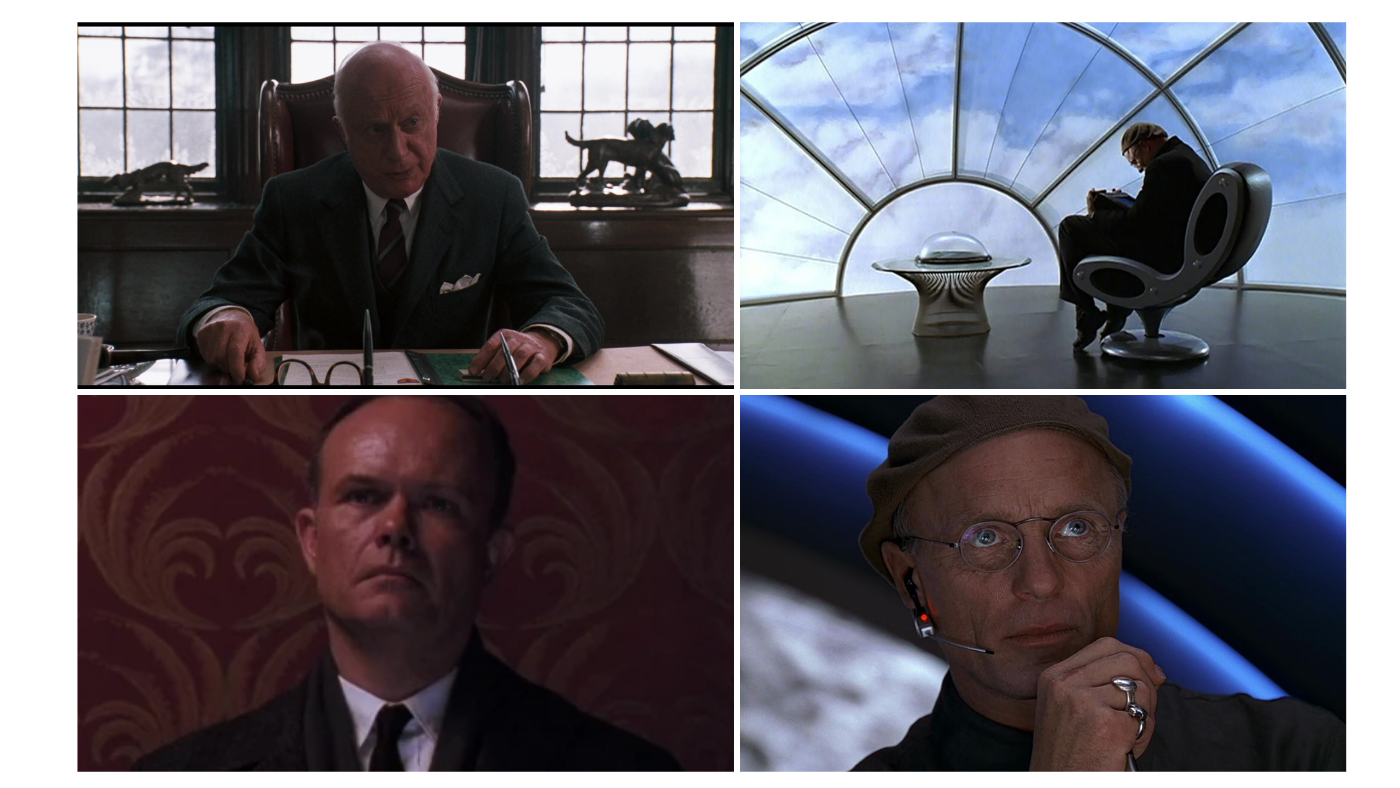
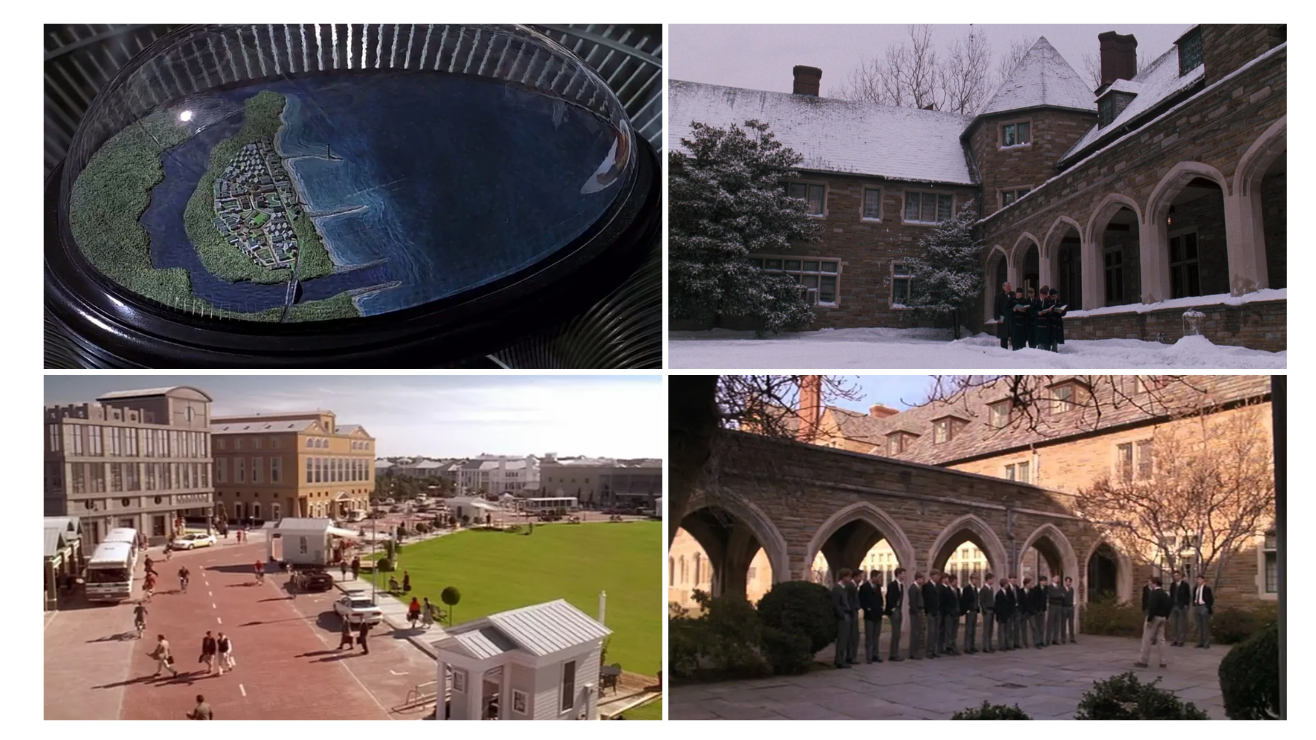
Peter Weir, the acclaimed Australian director, is known for films that place individuals within highly controlled social worlds and trace their attempts to break free from them. Dead Poets Society (1989) and The Truman Show (1998), though very different in setting and tone, both films centre on characters who awaken to the limitations of the systems surrounding them. In Dead Poets Society, this conflict emerges within the rigid traditions of an elite boys’ school, the Welton Academy, while in The Truman Show, it is transformed into a satirical, media-driven struggle between personal freedom and manufactured reality. This essay argues that The Truman Show represents both continuity and change in how Peter Weir expresses his directorial vision: while it continues his longstanding exploration of themes such as conformity, individuality, and self-realisation, it introduces significant shifts in visual style, narrative method, and industrial context.
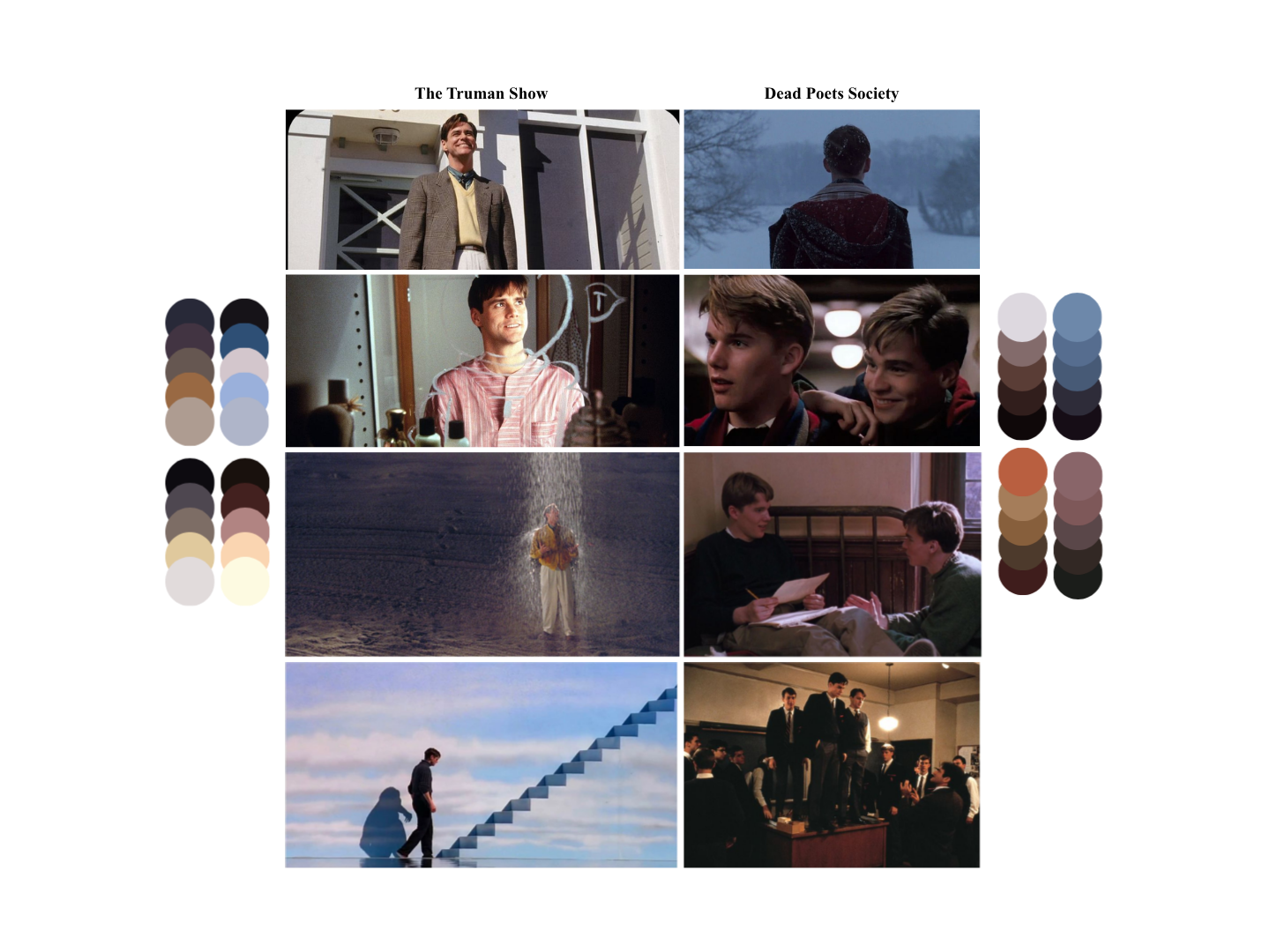
In both The Truman Show and Dead Poets Society, Weir utilises the contrast between warm and cool colour palettes as a means of articulating the emotional interiority of his characters. Yet while The Truman Show is suffused with warm tones that construct an illusion of comfort and stability, Dead Poets Society is marked by a cooler visual palette that reinforces the film’s underlying atmosphere of melancholy and emotional constraint.
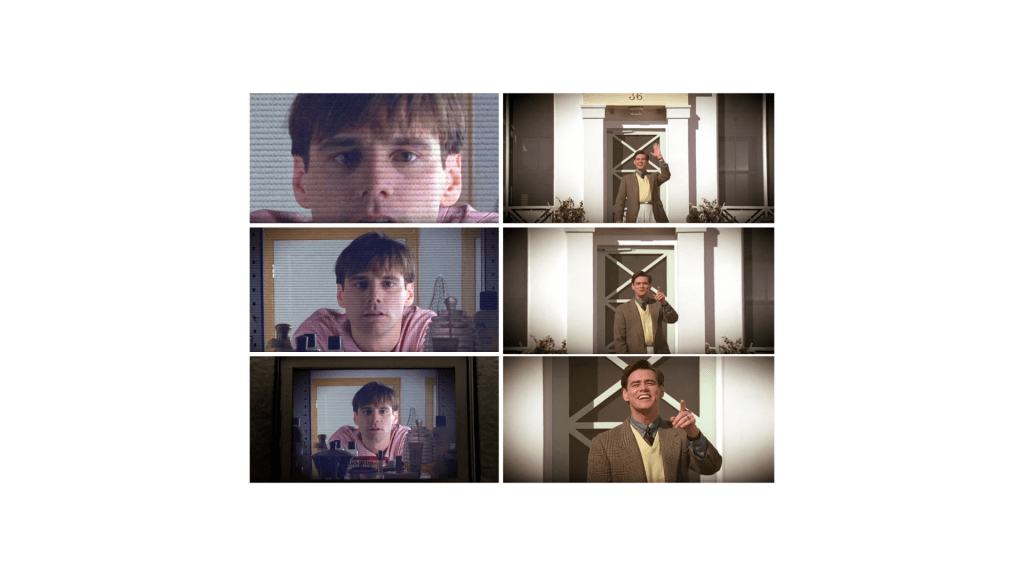
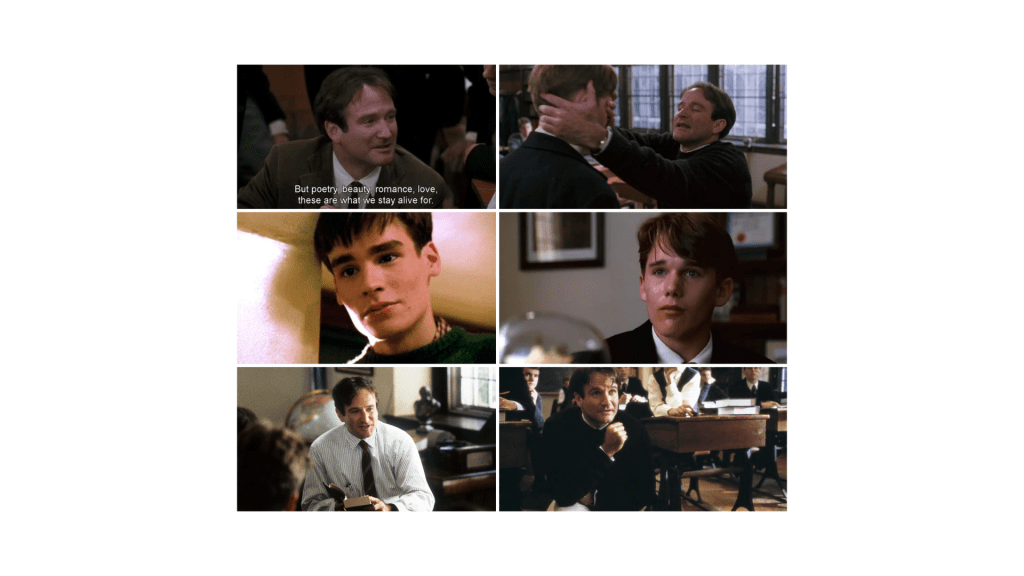
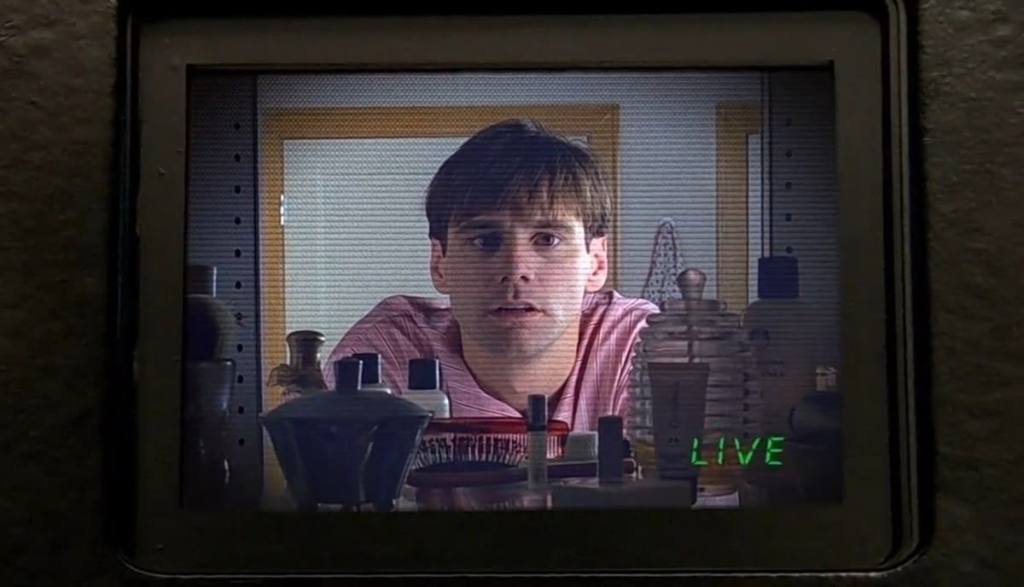
In terms of the cinematography of the two films. The cinematography of The Truman Show is closely aligned with its premise as a constructed reality show, incorporating camera-like movements such as frequent zooms and tracking shots that mimic the logic of live broadcast and surveillance. The camera often adopts positions that resemble hidden or observational viewpoints, reinforcing the idea that Truman’s life is constantly being recorded and controlled by the director, Christof. In contrast, Dead Poets Society employs a more intimate and character-focused cinematographic style. The film relies heavily on close-ups and mid-shots to capture subtle emotional nuances and reactions, drawing the audience into the internal experiences of the characters.
At the same time, both films make use of close-ups and occasional extreme close-ups to emphasise significant details and symbolic objects. In Dead Poets Society, close-ups of props such as books, photographs, and Neil’s crown serve to highlight themes of individuality and aspiration. Similarly, in The Truman Show, the camera frequently zooms in on Truman’s collage of Sylvia’s photographs, visually reinforcing his longing and his desire to find her. Through these differing uses of cinematography, Peter Weir demonstrates both continuity in thematic focus and variation in visual strategy.
While both The Truman Show and Dead Poets Society adopt a largely linear and classical narrative structure centred on a process of character awakening, they differ significantly in narrative perspective, construction, and resolution. In Dead Poets Society, the narrative unfolds in a straightforward and immersive manner, with little structural fragmentation. The audience experiences events alongside the students, gradually witnessing their growing awareness of the constraints imposed by authority, tradition, and parental expectation. This intimate perspective fosters emotional identification, particularly through characters such as Neil and Todd, whose struggles are presented from within the system they inhabit. By contrast, The Truman Show introduces a more complex, dual-narrative that alternates between Truman’s world and the real world: Christof and the audience of the show. This structure creates a sustained sense of dramatic irony, as Truman is the only one who does not know he is living in a constructed world.
Although both films explore the conflict between individuality and conformity, they diverge in the scale and philosophical implications of this struggle. In Dead Poets Society, the conflict remains grounded in a recognisable social context, where institutional discipline and familial pressure restrict personal expression. The characters’ awakening, while emotionally powerful, ultimately leads to tragedy, as their resistance cannot fully overcome the structures that confine them. In The Truman Show, however, the conflict expands into a more abstract and ethical dimension, raising questions about the legitimacy of a constructed reality that prioritises comfort over genuine freedom. Truman’s gradual realisation and later escape mark a decisive break from the system itself. Through this shift in narrative construction and resolution, Peter Weir reconfigures a familiar theme of self-realisation into a more self-conscious and conceptually mediated form, while maintaining continuity in his broader thematic concerns.
The contrast in budget and industrial context directly shapes each film’s scale and narrative ambition. Late 1980s Hollywood was dominated by mid-budget, character-driven films that focused on emotional realism and dialogue rather than spectacle. Furthermore, Dead Poets Society reflects broader social shifts in the late 1980s, particularly a growing emphasis on individual expression and a questioning of traditional authority within institutions such as education in American society. In the 1980s film industry, CGI was not yet widely used, and filmmakers tended to rely on naturalistic cinematography, often due to limited production budgets. For instance, Dead Poets Society had a budget of approximately $16 million, whereas The Truman Show had a budget of around $60 million. As a result, Dead Poets Society is set in relatively limited locations and places a strong emphasis on performance rather than technological effects.
However, the production context of The Truman Show differs significantly, reflecting the rise of high-concept cinema and media-driven narratives in the late 1990s. The film not only focuses on Truman’s pursuit of freedom, but also functions as a satire of mass media and consumer culture. Moreover, as budgets and technology increased, the film was able to utilise controlled sets and more complex production design, allowing for a broader conceptual scope.
In conclusion, The Truman Show should not be understood as a departure from Dead Poets Society, but as a reconfiguration of Peter Weir’s established directorial styles within a new cinematic framework. While both films explore individuality, conformity, and self-realisation, they differ in the methods of expression. While Dead Poets Society archives its impact through emotional intimacy and character-driven narrative, The Truman Show adopts a more self-conscious narrative structure, stylised visual design, and expanded industrial scale to present a sense of absurdity. Yet, these differences do not indicate a progression in artistic maturity, but rather demonstrate Weir’s ability to adapt his vision to changing cinematic contexts. Ultimately, The Truman Show represents a transformation in form, reflecting both continuity in theme and evolution in expression within Weir’s body of work.
‘He remembers those vanished years. As though looking through a dusty window pane, the past is something he could see but not touch.’
—In the Mood for Love
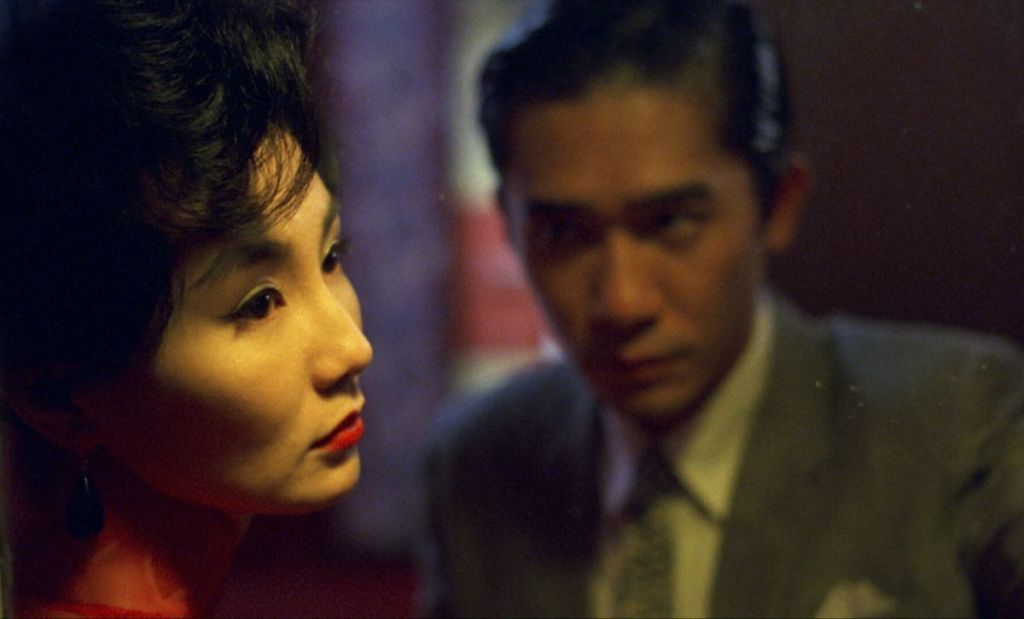
Wong Kar-wai’s movie, In the Mood for Love, tells the story of Chow Mo-wan and Su Li-zhen, who, after discovering that their spouses are having an affair, attempt to reenact their partners’ relationship to understand the betrayal. However, as the act gradually becomes real, their emotions flow between repression and ambiguity, eventually dissolving in silence.
The film’s mise en scène presents the complexity and subtlety of their relationship in a hazy and restrained manner. It concludes with the scene of Chow whispering into a stone hollow at Angkor Wat, merging narrative and imagery, and burying his unspoken sorrow within the passage of vanished time.
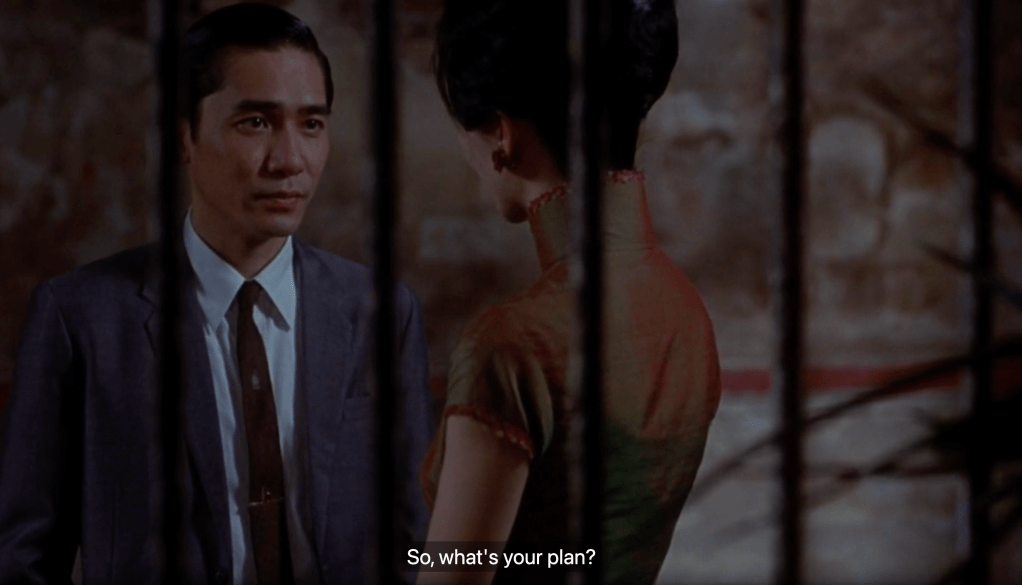
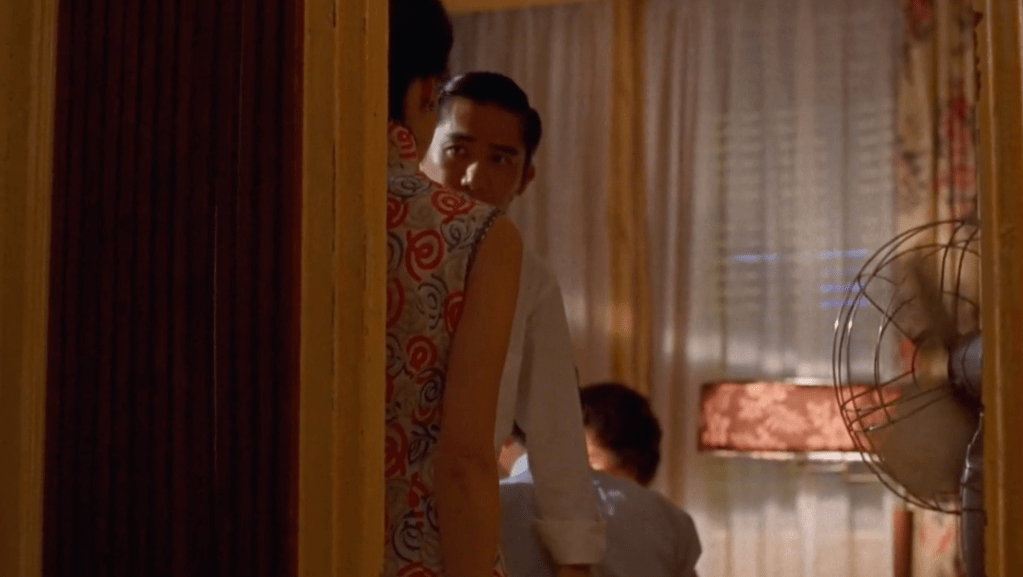
In the film, Wong Kar-wai repeatedly employs the ‘frames within frames’ technique, allowing the audience to experience the hazy and restrained emotions between Chow and Su from the perspective of a voyeur. The sense of ‘being watched’ echoes the narrative setting in which the two characters reenact the affairs of their unfaithful spouses, casting a delicate veil of ambiguity that cannot be pierced over their relationship. They seem to be free, yet are bound by moral constraints, struggling between desire and rationality.
In the scene where Su and Chow meet and converse (40:00-42:34), the voyeuristic perspective further intensifies the ambiguity of their relationship. It remains uncertain whether they have already fallen in love, or whether they, like the partners they resent, have betrayed the fidelity of love itself. Through the use of frames within frames, the presence of bars visually transforms their emotions into a state of confinement. Trapped within the moral framework of society, they suppress their desires, yet gradually sink deeper into them.
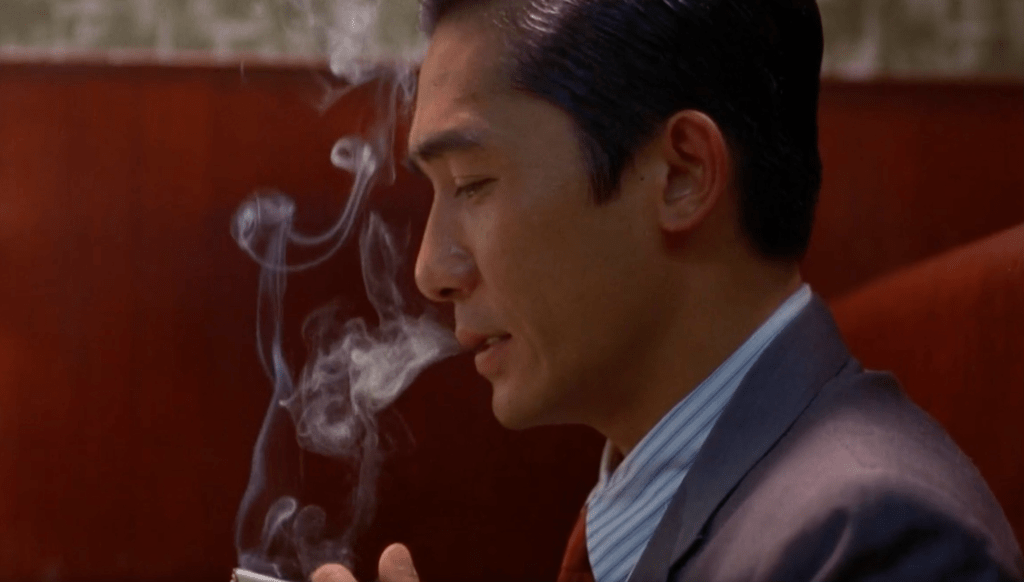
The repression of feeling within Chow and Su is symbolised through the imagery of smoke. The hazy, drifting smoke mirrors their restrained emotions—intangible and impossible to grasp. Therefore, in the film, cigarettes not only represent self-control but also embody suppression and escape.
In their first dinner together (28:00-31:00)—the beginning of their play—the cigarette in Chow’s hand symbolises his fear and repression upon realising his spouse’s infidelity. As the smoke slowly disperses, it becomes both a metaphor for the growing intimacy between the two and a foreshadowing of how their relationship will eventually fade with time. Yet, even after the smoke has cleared, a faint scent and delicate wisps remain in the air, just like their love, hidden, fleeting, yet leaving an indelible trace in Chow’s heart.
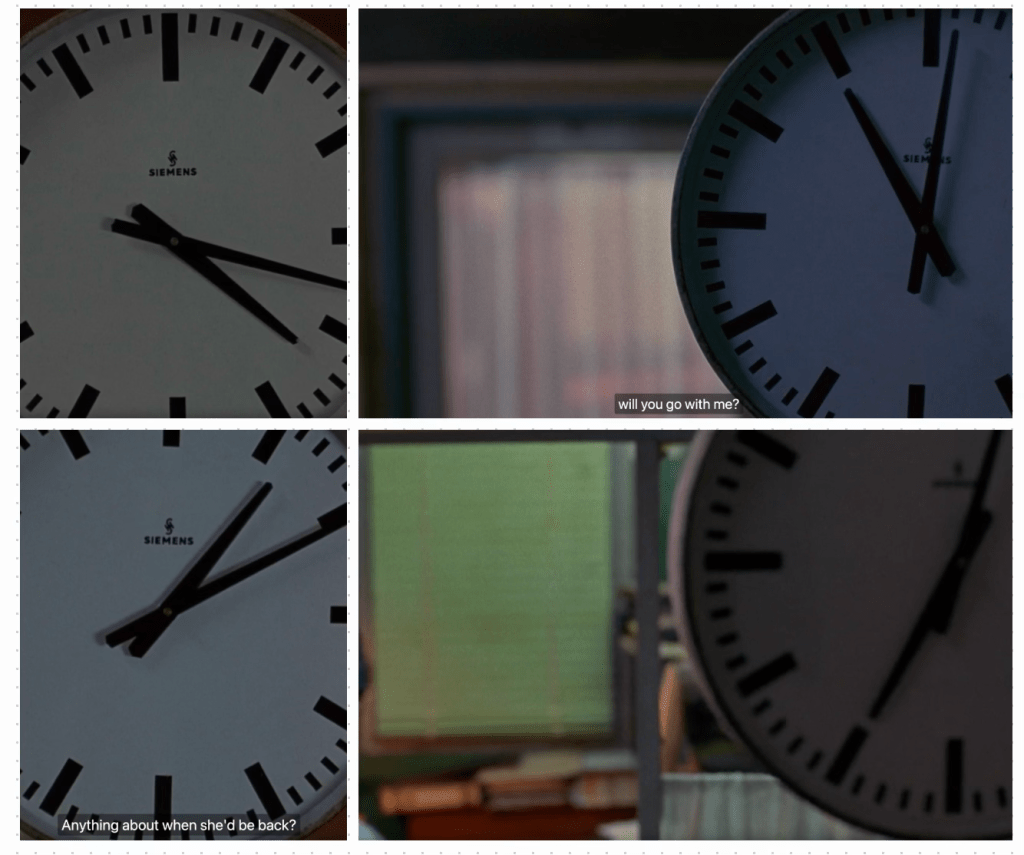
The passage of time gradually buries the emotions between Su and Chow. Wong Kai-wai uses the imagery of the clock to present the passage of time in the most direct way to the audience (7:04, 20:41, 37:10, 1:16:00), creating a sharp contrast with the delicate and floating emotions between the two. At the same time, through slow-motion scenes, he renders their romantic entanglement ambiguous and interwoven between reality and illusion.
In the mahjong scene at the beginning of the film (5:20-7:00), the interaction between Su and Chow, as well as their spouses, becomes subtle and dreamlike due to the combination of slow-motion long shots and the melody. The slow motion slows down and prolongs their relationship, yet within this illusory prolongation, their connection gradually fades away until it is finally swallowed by time.
Although Wong Kar-wai has already revealed the subtle distance between Chow and Su through the cinematography and visual imagery, the use of colour in In the Mood for Love especially symbolises the tension between their desire and restraint. While red in the film represents passion and impulse, green signifies rational suppression and emotional control.
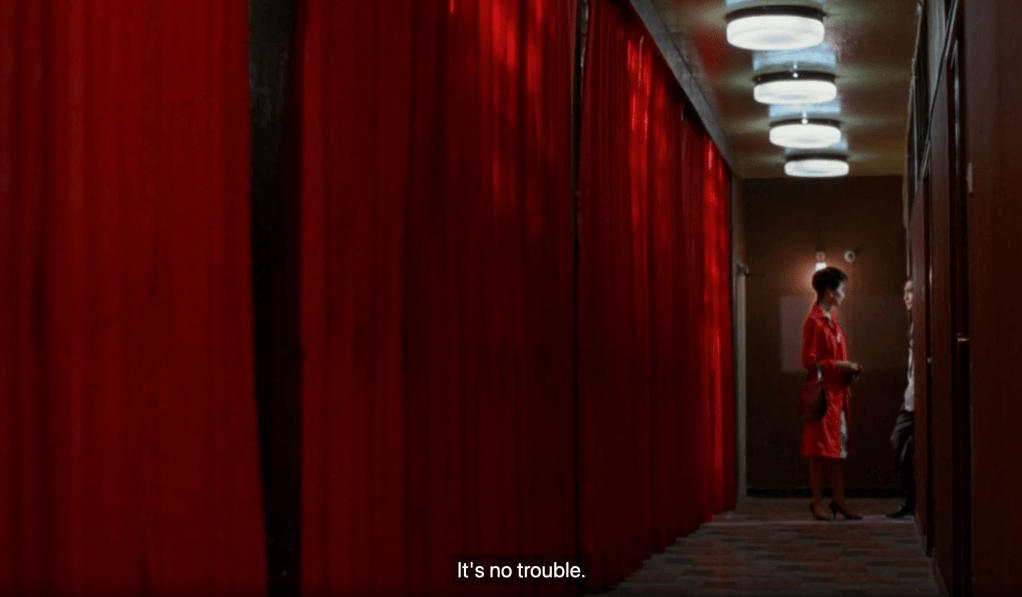
In the scene where Su goes to the hotel to find Chow after answering his call (54:02-56:00), she can no longer suppress her feelings for him, rushing to the hotel in a striking red coat. The hotel curtains are a deep, vivid red, while the floor is interspersed with faded shades of green. Against this background, the red of Su’s coat stands out even more prominently, symbolising the inner confrontation between her desire and restraint.
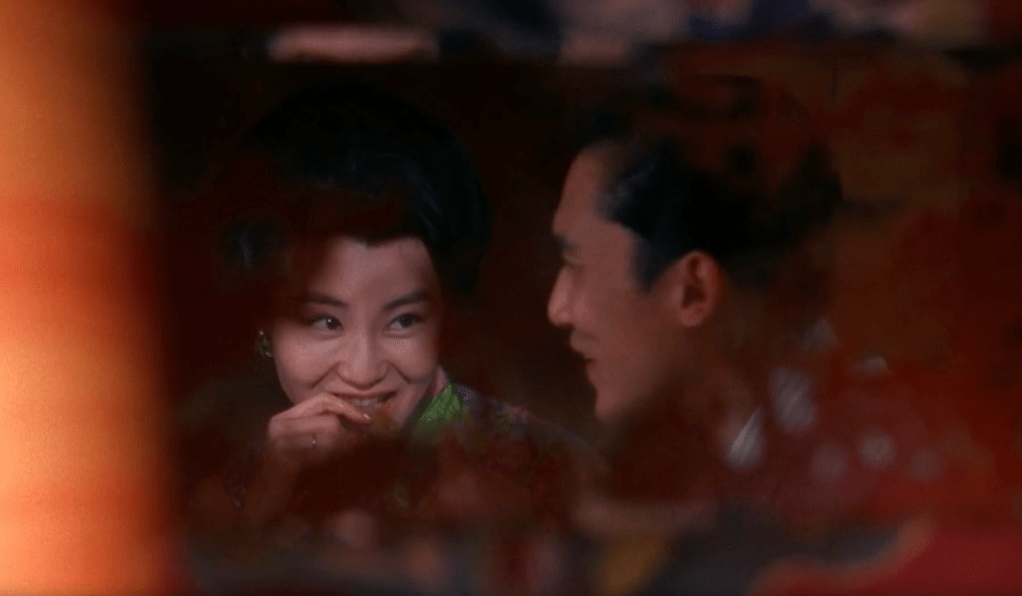
In the later scene where Su and Chow spend time together in the hotel (57:06), although she is dressed in a green chenogsam, everything around her is bathed in red. The green on her body suggests that a trace of restraint still lingers within her, yet desire has already drawn her deeply into the intoxicating joy of this forbidden love, from which she can no longer escape.
The love between Su and Chow has long simmered with the passage of time, and their blossoming years become a tragedy shaped by time and repression.
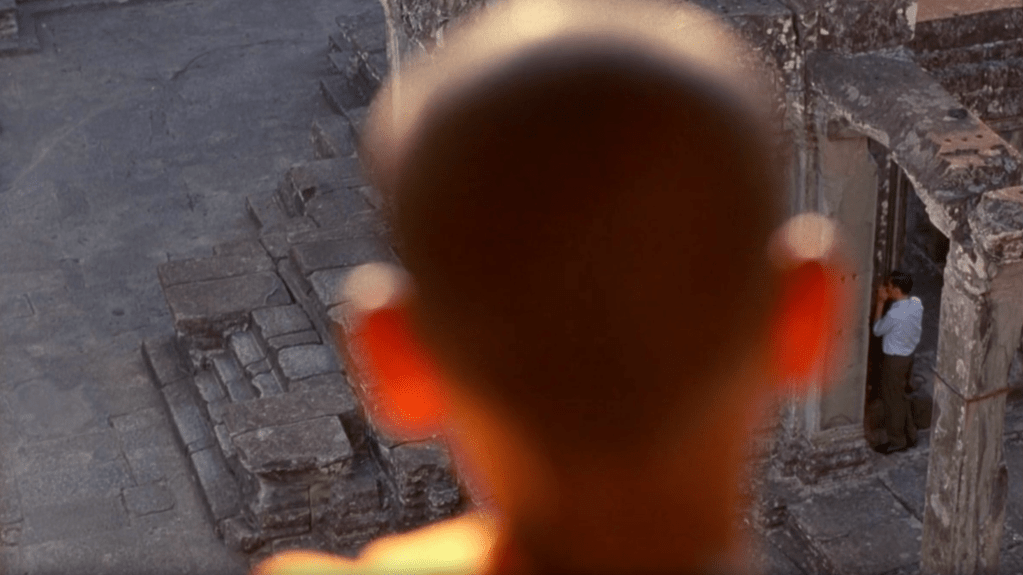
At the end of the movie (1:29:00-1:33:00), as the archival footage of Charles de Gaulle’s visit to Cambodia plays, the story of Chow and Su appears increasingly minor. Under repression, Chow’s feelings for Su grow deeper and more vigorous, yet all he can do is whisper his unspeakable love into the stone hollow of Angkor Wat. When the camera shifts to a higher angle, a young monk silently watches Chow from above. The love between Chow and Su seems to have always been stared, and has been eternally sealed within time and memory.
Through the meticulously crafted mise en scène, the use of frames within frames, drifting smoke, and the contrast and symbolism of colour, Wong Kar-wai gradually reveals Chow’s descent from rational restraint into emotional entrapment, unfolding like the slow diffusion of smoke.
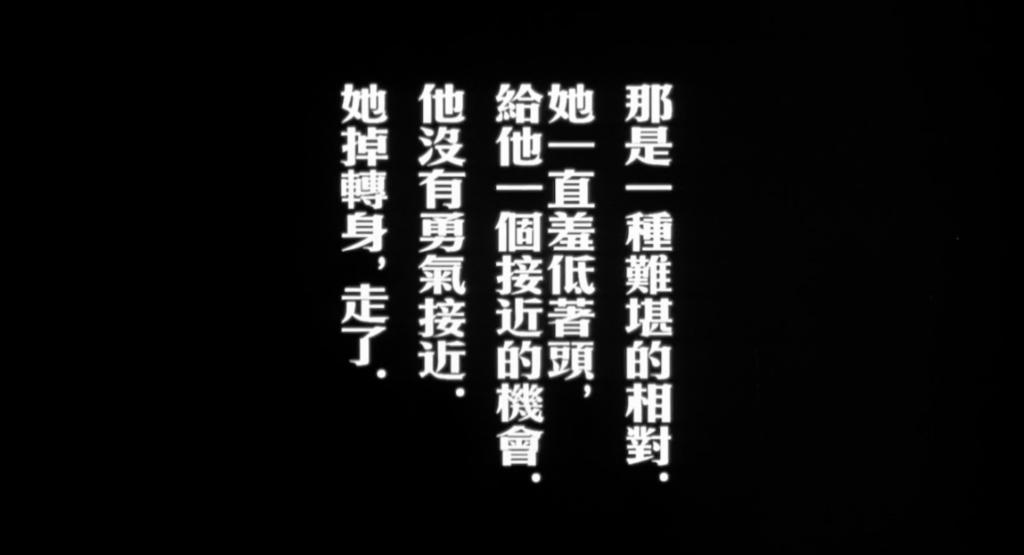
He can neither possess Su nor escape the emotional prison they have built together. As the film’s opening lines say: ‘It is a restless moment. She has kept her head lowered to give him a chance to get closer. But he could not, for lack of courage. She turns and walks away.’
In late October 1945, Jean-Paul Sartre delivered a lecture in Paris at the Club Maintenant entitled Existentialism Is a Humanism. The lecture was later edited and published in 1946 as a philosophical work of the same name. In this lecture, Sartre introduced the first core concept of existentialism: existence precedes essence.
For Christians, “essence” refers to the mission and purpose bestowed upon individuals by God before their birth. However, regardless of religious belief, philosophers such as Diderot, Voltaire, and Kant all proposed the notion of a shared “human nature.” In their view, human nature constitutes a universal essence common to all people, and each individual is merely a particular manifestation of this universal essence. Sartre and existentialism, however, reject the existence of such a pre-given human nature.
Sartre argues that human beings possess no a priori essence. Instead, he asserts that existence precedes essence: human beings are first thrown into the world, gradually come to understand themselves through their encounters with the world and with themselves, and only then define who they are through their actions and choices. This position is closely connected to Sartre’s inheritance of Cartesian philosophy, particularly his emphasis on the cogito—the idea that the subject emerges through consciousness and self-reflection, rather than through any innate or predetermined essence.
Thus, in Sartre’s view, what makes a human being “human” does not stem from a pre-existing nature or purpose, but from the process of experiencing the world, making choices, and assuming responsibility. Human essence is not given in advance; it is continuously formed after existence, through experience and self-definition.
This essay will therefore use the narrative structure of The Truman Show to illustrate this transformation of the concept of “essence,” and, from an existentialist perspective, further explore the philosophical question of what it means to be human.
1. A Being Thrown into the World
In his lecture, Sartre describes human beings as beings thrown into the world, whose existence carries no inherent or pre-established meaning. Yet this existentialist proposition does not seem to fully apply to The Truman Show. For Truman, meaning is not constructed after existence through his own choices, but rather predetermined before his birth. He is defined as a “person” who grows under the gaze of cameras and audiences, rather than as a subject truly living in the real world.
In this sense, Truman more closely resembles a character placed within a system. His life trajectory, behavioural logic, and even life goals are carefully planned and guided by the enclosed system of the television set. Although his actions appear on the surface to be freely chosen, any “variable” he produces under conditions of deception and manipulation is continuously corrected and optimised by the system, ultimately leading back to a predetermined narrative outcome. Truman’s choices are therefore not genuine acts of freedom, but rather permitted choices within a pre-established structure.
However, this does not mean that the film denies Sartre’s emphasis on absolute freedom or multiple possibilities. On the contrary, before Truman becomes aware of the existence of freedom and choice, his consciousness can only operate within the given framework, passively complying with each arranged action. It is only when Truman gradually realises the falsity of his world and perceives the possibility of freedom and choice that he truly confronts multiple paths of existence and begins to make non-preordained choices that no longer serve the established narrative.
In Sartre’s famous example of the café waiter, the waiter’s understanding of his own essence does not arise from genuine self-knowledge, but from bad faith. By fully identifying himself with the role of “waiter,” he convinces himself that this role constitutes his essence, thereby evading the responsibility and anxiety that accompany freedom.
Yet unlike the tray he carries or the coffee cups upon it, the waiter is not a fixed object. He is not entirely defined by function or utility, but remains a fluid and changeable subject. For this reason, human beings cannot be assigned a stable, a priori essence in the same way objects can. Human existence is always in flux, and human essence can only be generated through experience, choice, and self-consciousness.
For Sartre, self-consciousness is not a static form of introspection, but an ongoing process of interaction between the individual and the self. It is through awareness, denial, or acceptance of one’s own condition that individuals continuously shape their mode of existence. Thus, what makes a human being human is not the role one plays, but the fact that no role can ever fully exhaust the self.
In The Truman Show, however, bad faith does not originate from Truman himself, but is produced and sustained by the world in which he lives. Within the reality-show system, the director deliberately constructs a form of bad faith and disguises it as good faith. Under this disguise, Truman gradually comes to believe in and internalise this imposed belief, accepting his social roles as an ordinary office worker, husband, and citizen.
This acceptance does not result from free choice, but from passive acquiescence to an assigned essence. In this respect, Truman closely resembles Sartre’s café waiter: both identify themselves with fixed roles and unconsciously evade the responsibility of freedom. Although both possess some awareness of their subjectivity, they nonetheless choose to see themselves as stable, unchanging objects rather than evolving subjects. This is precisely why they can temporarily coexist in apparent harmony with a world structured around certainty and predictability.
Because Truman lives within a fully controlled environment, his understanding of his own existence is shaped into an illusion—namely, the belief that he has possessed a fixed and unchangeable essence since birth. In reality, however, the question of who Truman “is” only becomes meaningfully definable once he leaves the fabricated world. If everything he previously experienced was based on deception and fiction, then the self-knowledge and so-called essence formed within that world must also be subject to negation.
In other words, Truman’s previously assumed essence does not emerge from authentic encounters with freedom and reality, but from attachment to a constructed and false reality. As such, this essence lacks existential legitimacy. Only by leaving the fabricated world and confronting real uncertainty and freedom can Truman redefine his existence through his own choices.
2. The Absurd World and Freedom
Truman’s freedom does not begin with action, but with doubt. It is at the moment doubt emerges that Truman first becomes aware of himself as a subject, and the world he faces begins to reveal its absurdity. This awakening does not immediately grant him absolute freedom, but it creates the condition for freedom to become possible.
Human beings constantly seek their “essence,” yet this pursuit is fundamentally a form of resistance against an absolutely absurd world. We cannot accept that our existence lacks pre-given meaning, nor can we accept the world’s silence in response to our demand for meaning. As a result, we attempt to locate a non-existent a priori essence to counter this absence. As Camus argues, the absurd does not reside solely in the world or solely in human consciousness, but emerges from the relationship between the two: humans relentlessly pursue meaning, order, and explanation, while the world refuses to respond. It is this tension that constitutes the absurd.
In The Truman Show, absurdity does not manifest as chaos or disorder, but as Truman’s gradual realisation that the world he inhabits lacks genuine reality. The absurd does not appear at the moment of collapse, but at the moment the world begins to shed its disguise. The director’s and crew’s attempts to manage unexpected incidents function as a metaphor for psychological defence mechanisms—how individuals instinctively preserve the rationality of their existing world when faced with potential threats.
When the stage light labelled as a star falls from the sky, Truman does not interpret it as an ominous sign. Instead, he quickly incorporates it into everyday experience and rationalises it. This reaction echoes Sartre’s claim that the meaning of signs is not inherent, but assigned by the subject. How we interpret an event depends not on the event itself, but on how we choose to understand it (cogito). Through this reconstruction of meaning, Truman temporarily preserves his trust in the world.
Similarly, when Truman hears the production team’s communications through his car radio, he does not immediately recognise the abnormality. Rather, he interprets the incident according to the familiar and stable logic of his daily life. At this stage, the absurd has not yet fully emerged—the world is still barely maintained as something “understandable.”
For Truman, Fiji represents a gateway to the self; for humanity, each of us possesses our own “Fiji.” It is through moving toward this destination that we begin to realise that essence is not predetermined, but must be reconstructed through freedom and choice. The obstacles encountered along the way are manifestations of the absurd—yet it is precisely this absurdity that propels us toward essence.
In the film, once Truman becomes aware of the abnormalities in his world, he attempts to reach Fiji—a place that symbolises the “true self” for him. Fiji’s significance lies not in geography, but in Lauren, the only person Truman truly loved within the constructed world. Guided by this emotional truth, Fiji becomes imbued with the meaning of authenticity and selfhood.
The resistance Truman encounters, however, comes not from a single force, but from the world as a whole: his wife, his friends, and even the city’s transportation system all work to prevent his pursuit of selfhood. These obstacles are not accidental, but deliberate mechanisms designed to preserve the established order.
In this sense, they function as tests of freedom. When individuals submit to such resistance, they enter what Sartre calls bad faith: they choose to believe in a “truth” that no longer needs to be questioned, thereby accepting what should have been resisted. Through rationalisation or denial, individuals abandon the responsibility of freedom and retreat into a world that appears stable but is fundamentally untrue.
3. “To Be or Not to Be”: Freedom, Choice, and Responsibility
Within existentialism, the question of “to be or not to be” does not concern survival alone, but whether one is willing to assume the responsibility that accompanies freedom and choice. For Sartre, human beings are always absolutely free; even the refusal to choose is itself a choice. In this sense, the dilemma Truman faces at the film’s conclusion—whether to stay or leave—serves as a quintessential existential metaphor. It is not about physical departure, but about whether one chooses to confront or flee from freedom.
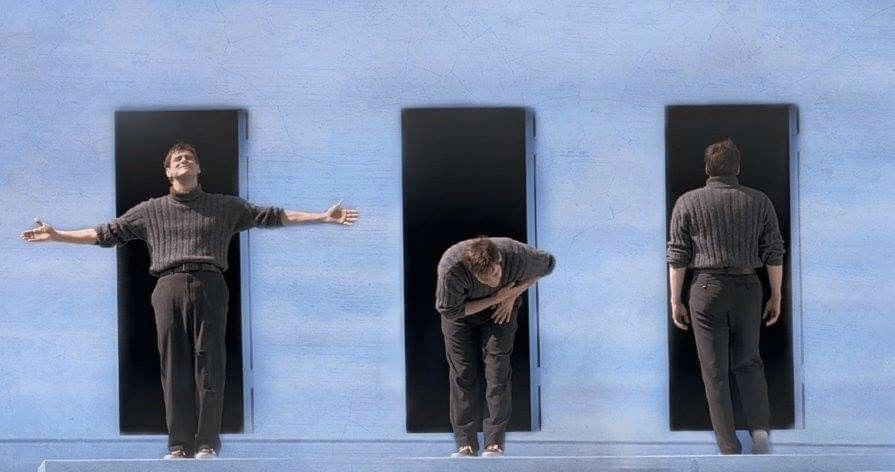
After Truman has overcome all visible obstacles in his life, what ultimately stands before him is not safety, but absolute freedom. The final sequence at sea does not represent mere physical escape, but a profound existential metaphor. The violent waves, the storm, and the fragile boat symbolise the ultimate barriers individuals face in the pursuit of selfhood—forces that compel obedience and self-deception. Once these external obstacles lose their power, what remains is the most terrifying truth of all: freedom itself.
At the film’s end, Truman confronts not merely the exposure of the show but the fundamental truth of human existence. The reality he faces—defined by uncertainty, absurdity, and the absence of guarantees—is the basic condition of being human. What makes Truman “human” is not his fame, visibility, or assigned identity, but his courage to confront uncertainty and accept absolute freedom.
The director’s final revelation—that Truman is a beloved global figure watched by millions—offers him a ready-made identity, one defined entirely by external authority. From an existentialist perspective, this closely resembles the theological notion of essence granted by God: a role imposed before choice and experience. Yet this identity fails to answer Truman’s question, because it is not chosen by him. It is imposed, not generated through authentic existence.
Truman’s decision to leave, therefore, marks the moment he truly becomes human. By rejecting an identity defined by others, he refuses to remain in bad faith and instead embraces the absurdity, uncertainty, and responsibility of freedom. In doing so, he does not discover a pre-existing meaning of life, but begins to create his own. His choice affirms the existentialist claim that what makes us human is not a meaning given at birth, but the meaning we actively construct through our encounters with the world and with ourselves.
4. What Does It Mean to Be Human?
In existentialism, freedom is not a state of liberation, but a responsibility that must be borne. Truman’s departure does not lead to a certain meaning, but to an uncertain yet authentic mode of existence. To be human does not mean possessing a unique essence, but refusing to allow others to choose on one’s behalf. Truman becomes human not because he discovers his true self, but because he refuses to continue living a life defined for him. In a world that offers no guaranteed meaning, choosing to act and to assume responsibility is precisely what it means to be human.