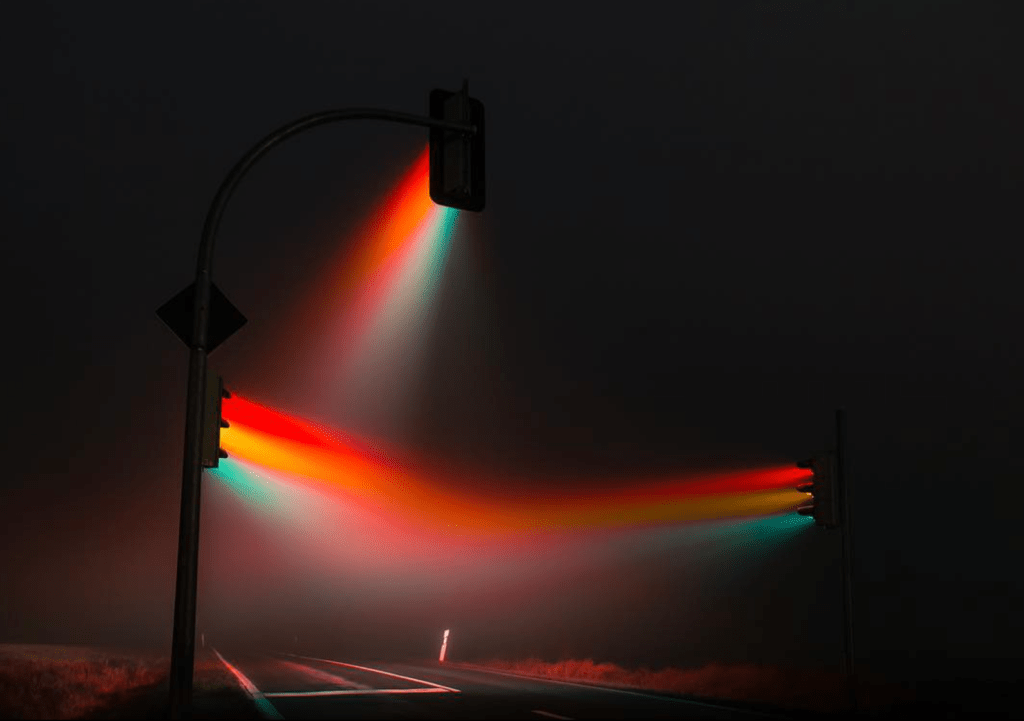
The night before, a torrential rain had fallen, and heavy clouds pressed low, sealing off the sky, while the rain dissolved countless neon lights into blurred, trembling fragments of colour—red, green, and yellow—so that even the leaves, beaten from the trees, seemed to drift endlessly into a dark sea that shimmered with scattered hues.
Tonight, the rain had stopped. Marcovaldo lay alone on the still-damp grass, gazing at the sky for a long time, tracing back through the fragments of his recent life, only to feel that somehow he was less than the moon hanging above him. He was exhausted—though he did not yet understand it—an exhaustion that had grown quietly within solitude itself.
It was a long dream, though Marcovaldo never realised it. In that dream, he tried to grasp the moon, yet it remained suspended at the edge of the sky, distant and unreachable, never descending. The city lay in complete darkness, and only the moon illuminated the night.
He rose from the grass and walked toward the sea not far away, where moonlight lay scattered across the surface of the water like fragments. He tried to catch those broken pieces of light, but they always slipped away from his hands.
At last, he leapt into the sea, as though shattering the moon itself into pieces. The cold struck him sharply—a piercing chill born of the autumn wind mingling with seawater. Fish brushed past his body as he plunged deeper, and somewhere in that descent, the moon, too, seemed to fall into the sea.
In the deep blue darkness, he caught sight of something white, pearl-like, emitting a faint and unreal glow. He swam closer, yet the vision vanished before he could reach it. Around him, silver fish began to appear, scattering like fragments of moonlight, drifting and dissolving. Those fleeting, weightless forms seemed to arise from within himself, like the countless thoughts he could neither grasp nor hold.
He paused, still unaware that he could breathe underwater, as everything continued as naturally as life on land. Around him, besides the scattered silver light, countless bubbles rose in silence. He reached out and gathered a small cluster of them in his hand, but in that very instant, they disappeared.
When he returned to the surface, the moon still hung high above, yet the distant sea flickered strangely with red and green lights. Slowly, almost imperceptibly, the moon was swallowed, and the sky grew brighter, until it was filled with fractured, restless light.
Marcovaldo awoke to find his body soaked through, lying in a shallow pool. Behind him, by the roadside, stood two sets of traffic lights facing one another—like strangers, or perhaps like friends, or lovers caught in a silent exchange.
A harsh light flickered across his face, but he paid it little attention, rising from the pool and wandering across the grass. The city was quiet now, as if only he remained within it. Passing cars occasionally cast their glaring headlights toward him, a brightness he could scarcely endure—like the light in his dream, burning, relentless, and unceasing.
He lifted his gaze to the sky, which was no longer the same as in his dream. The deep darkness had dissolved into a sky filled with artificial light, where even layers of clouds could be seen. The glow of countless high-rise buildings, the passing cars, and the lonely traffic lights had swallowed the moon into their brightness, and the stars, too, had been consumed, buried within illuminated clouds.
The buildings rose high, glaring with cold light, and Marcovaldo felt that in this excessively urbanised city, he had nowhere to stand. The patch of grass beneath his feet seemed the only place where he could pause.
From time to time, a bus passed by. Looking into its empty interior, Marcovaldo felt an inexplicable sadness. The white light inside resembled the light from his dream, yet it was not bright enough. Still, it unsettled him, as though it were trying to draw him back into some dark, damp basement.
Dragging his aching body, he made his way toward the sea and sat alone on a bench, letting the sea wind, the autumn air, and the distant sound of waves pass through him.
The traffic lights remained lit, unwilling to rest. Their pale, powerless glow spread thinly across the road, while in the distance the city still glittered with excess light. Water from his clothes seeped into the bench beneath him, and the moon seemed to rise slowly from the sea, only to sink back again.
He glanced at his watch—it was already three in the morning. Strangely, his heartbeat felt unusually loud, as though some force were moving through his body, searching for a way to break free.
He longed to see the moon from his dream once more—on a night that was utterly dark and silent, where there would be nothing but the moon, the sea, a few faint stars, and himself. Perhaps in the dim depths, perhaps upon the shimmering surface, the moon would slowly emerge again.
Marcovaldo lay back on the bench, water dripping from his clothes and sinking into the ground. The sky grew so dark that almost nothing could be seen.
Later, just before the sun rose, the moon appeared once more at the edge of the sky, faint and distant, and his clothes were nearly dry. The sound of passing cars grew louder, so loud that the traffic lights no longer flickered like neon signs. The sky was half deep blue, half ink-black, and the buildings no longer cast their oppressive glow.
Marcovaldo lay there in stillness. He reached out, grasped the moon, and sank with it—and the stars—into the sea.
At that moment, the morning sun began to rise. Fallen leaves drifted gently onto his face, while in the water below, his reflection moved softly with the current.
This work is a derivative piece inspired by the original text, Marcovaldo by Italo Calvino.


Leave a Reply