“The soul of the sluggard craves and gets nothing, while the soul of the diligent is richly supplied.”
Proverbs 13:4
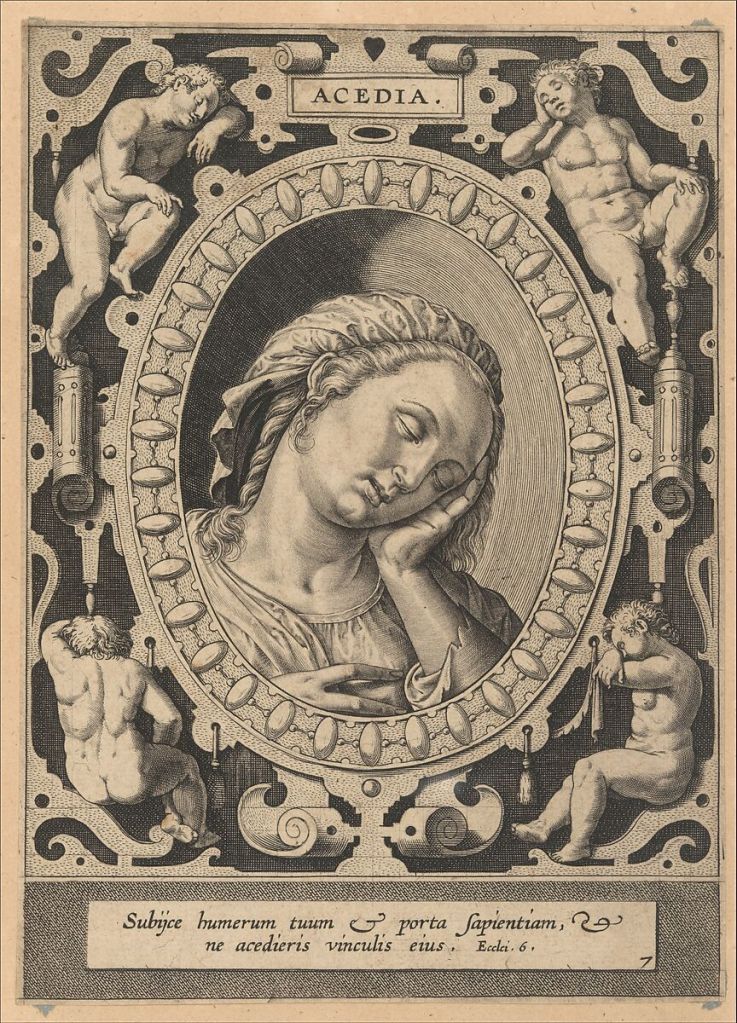
In Catholic tradition, sloth (acedia) is not mere laziness but a spiritual failure to love God fully. First articulated by the Desert Fathers, such as Evagrius Ponticus, as the “noonday demon,” it described a restless apathy that distanced the soul from divine purpose. Later, Thomas Aquinas defined it as sorrow or indifference toward spiritual good. As one of the Seven Deadly Sins formalised by Pope Gregory I, sloth represents not inactivity, but a refusal of spiritual engagement: a quiet withdrawal from grace and meaning.
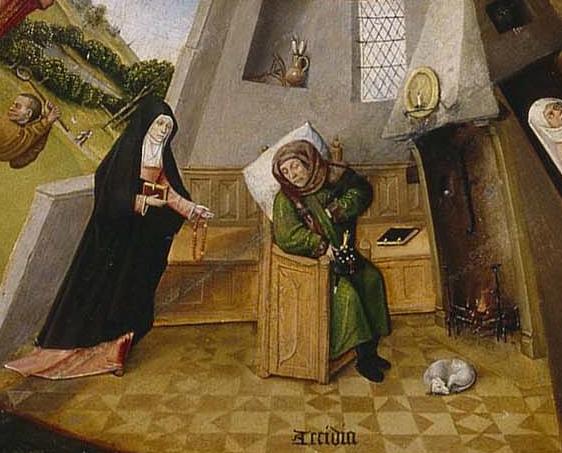
Sloth is a state of stagnation, and stagnation is often born from fear—not the fear of action itself, but of what action might reveal. To move forward is to risk failure, exposure, or change; to remain still is to avoid that confrontation. In this sense, sloth becomes a quiet defence mechanism, where inaction protects the self from uncertainty. What appears as apathy may in fact be a concealed anxiety, a reluctance to engage with a world that demands response. Stagnation, then, is not empty, but filled with an unspoken fear of consequence.
For me, the stagnation brought by sloth is not a freezing of time, but a more cruel form of acceleration. As the will gradually loosens and action is indefinitely deferred, time does not wait; instead, it slips away more rapidly in silence, pushing the individual toward an irreversible process of depletion and eventual end. This stagnation is not stillness, but a passive descent—in inaction, life is slowly drained away.
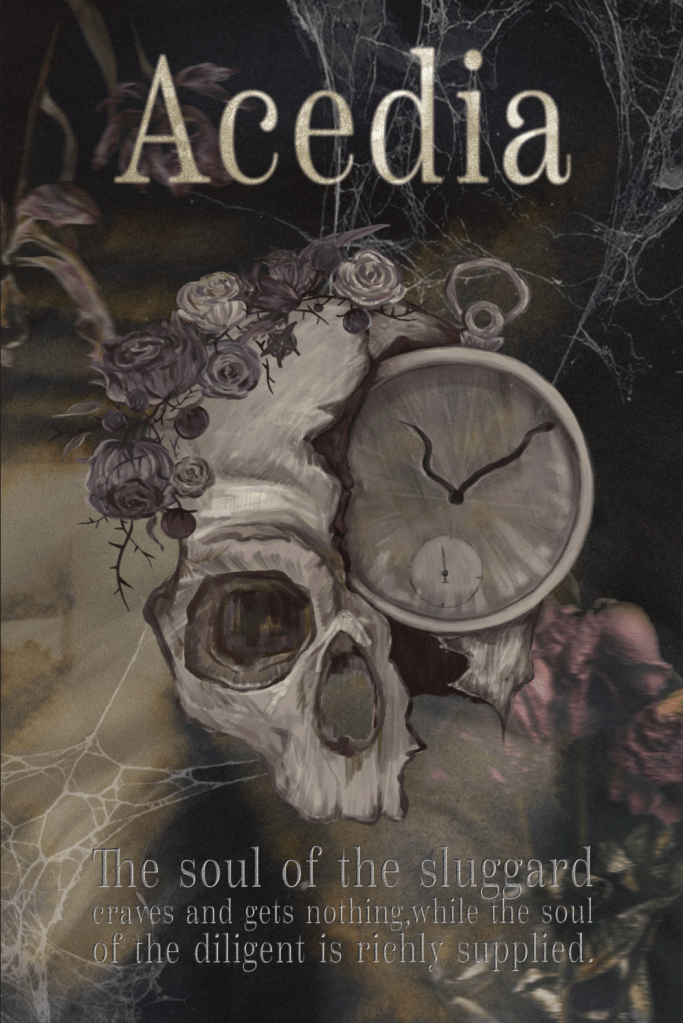
I translate this contradiction into visual symbols: a continuously running clock is embedded within an already fractured skull. Time proceeds with precision and indifference, yet the subject that contains it has already collapsed. Consciousness is no longer the force that governs time, but becomes a vessel eroded by it. The cracks signify not only physical breakage, but also the disintegration of the psyche and the loosening of the sense of self.
The once vivid red flowers gradually lose their colour, fading into withered tones of grey and purple, symbolising the diminishing of vitality and desire. Thorns entangle them—not merely as external obstacles, but as an internalised restraint. In the absence of action, the individual becomes trapped by their own inertia and fear, unable to break free. The image, therefore, does not simply point toward death as an endpoint, but presents a process: as time continues to move, life is hollowed out, ultimately leading to a silent dissolution.

