For God has not destined us for wrath, but to obtain salvation through our Lord Jesus Christ
Thessalonians 5:9
Wrath, in Roman Catholic theology, is one of the seven deadly sins. A strong feeling of hatred or resentment with a desire for vengeance, wrath is overwhelming and destructive.
But what brings us to wrath? Psychologically, wrath does not emerge in isolation, but is often rooted in fear. When our fear cannot find an outlet in escape, it transforms into confrontation, and anger becomes a secondary response to perceived threat. Our frustration, uncertainty about the future, and other negative emotions also trigger anger and aggression in our minds.
In Freudian psychology, projection could be a representation of wrath: we project our internal fears or insecurities onto others, and thus jealousy and resentment may not originate from external stimuli, but from the fear of inadequacy within ourselves.
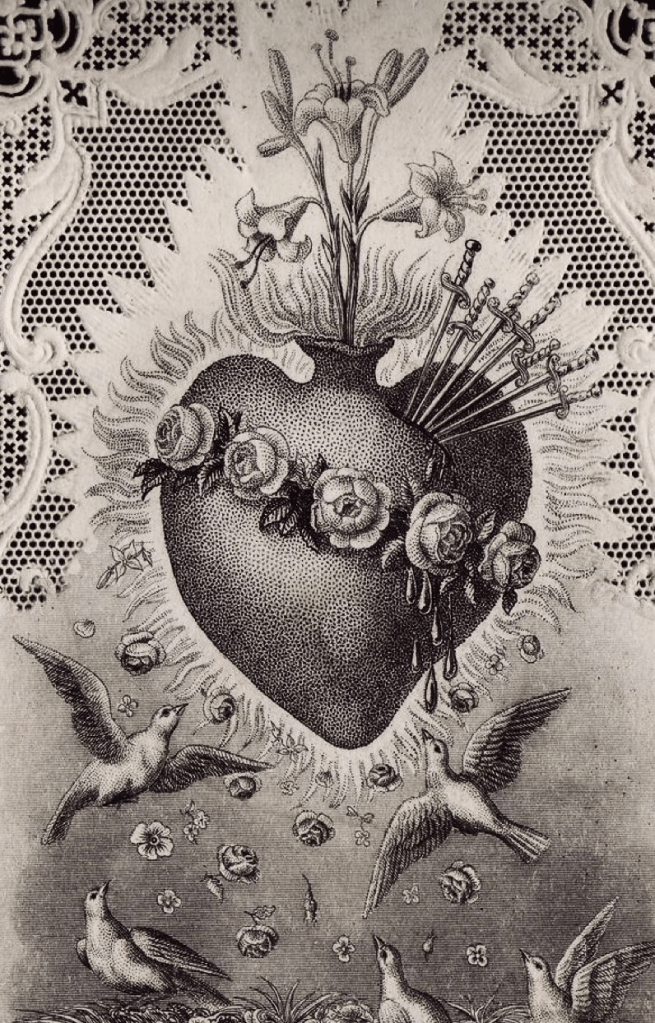
In Roman Catholic theology, the Sacred Heart represents the divine love of Jesus Christ for humanity. It is not only a symbol of love, but of sacrificial, redemptive love: a love that endures suffering for the sake of others.
The pierced, crowned with thorns, and set aflame heart signifies both suffering and redemption, revealing a form of love that persists despite pain and rejection.
However, in my work, this heart is deliberately inverted. What was once a burning symbol of divine love is distorted into a heart consumed by anger and desire, transforming from an emblem of love into a vessel of emotional disorder.
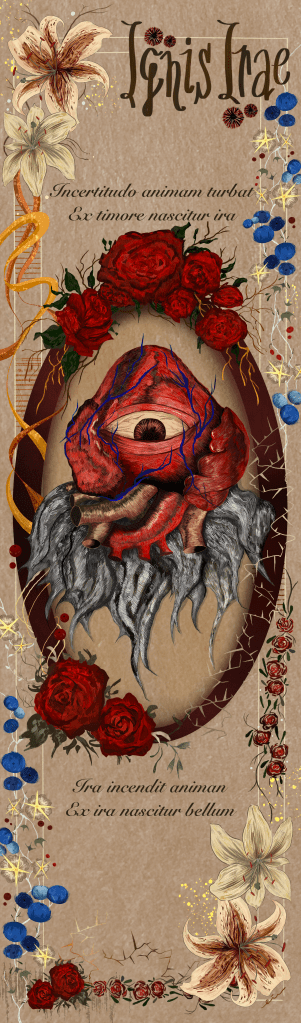
Ex timore nascitur ira
(Eng) From fear, anger is born
Our fear of the future drifts like dark ash—like a flame that burns as a ghost. The heart is blood-red, yet blue veins wind across it like creeping vines, spreading and entangling—roots of fear that grow within us and extend outward into the world.
The inverted Sacred Heart rests upon a bookmark. Life unfolds like a book, and this mark remains—both a warning and a reflection of what is real.
The roses, thorns, and lilies surrounding the heart form a symbolic framework that both beautifies and intensifies its distortion. Roses bloom with the language of love and desire, yet their thorns reveal the violence embedded within that beauty. The thorns echo suffering, piercing through the illusion of purity, while the lilies, often associated with death and mourning, introduce a quiet stillness of loss.
The heart of wrath was once beautiful; yet under the weight of desire and hatred, its beauty slowly withers away. The bloodshot eye set within the heart embodies a vision veiled by hatred and disgust. It has grown weary, altered by all that it has endured, no longer able to see clearly.
 Eileen's World
Leave a comment